martes, 10 de mayo de 2011

1880's Anónimo

No data, anónimo
Comment: posiblemente sirviera de base para una ilustración, ver: 1882 William Gray Dixon, The land of the morning : an account of Japan and its people

1882 William Gray Dixon, The land of the morning : an account of Japan and its people


Fotografía anónimo
1880's, Kusakabe Kinbei,colodión y coloreado a mano
Author: William Gray Dixon (1854-1928)
Illustrator: J. Bayne (no data)
Title: The land of the morning : an account of Japan and its people (p. 509)
Publisher: Edinburgh, James Gemmell
Fuente: Internet Archive 
Comment: La fotografía que sirve de base fue tomada en 1880's (Kusakabe Kinbei ?). Elementos similares son los personajes central y derecho sobre la figura y la escalera. Los personajes a pie de la escultura pueden ser añadidos como resultado de una combinación de ambas imágenes.

viernes, 6 de mayo de 2011

miércoles, 4 de mayo de 2011

1865 The Illustrated London News


Fuente: ebay
The Daiboodh, or Colossal Bronze Image of a Buddhist Idol, in the Temple of Kakamura, Japan
Fuente: University of Puget Sound
 The Illustrated London News 1865 (18 de febrero, página 193)
Título: The Daiboodh,or Colossal Bronze Image of a Buddhist Idol,in the Temple of Kamakura, Japan
Size: 280 mm x 410 mm
Fuente: ebay
Observaciones:  ¿es posible que el dia sea el 18 de febrero? (tal vez el 25?).
En el texto se puede leer que su corresponsal en Yokohama (Charles Wirgman ?) ha enviado un esbozo para el grabado de la ejecución de dos japoneses relacionados con el asesinato de dos oficiales ingleses, el major Baldwin y el lieutenant Bird cuando iban a visitar el Daibutsu de Kamakura. Este suceso es conocido como el incidente Geba y que es justamente el que sirve de excusa para esta ilustración en el The Illustrated London News:
The Geba Incident
At the end of the Tokugawa shogunate there were several incidents involving violence against foreigners, the most famous of which is the Namamugi incident. In 1864 two Britons were slashed to death at this intersection by some Japanese men[16].

On November 22, 1864[17] British cartoonist Charles Wirgman and photographer Felice Beato were in Enoshima near Fujisawa, where they met Major Baldwin and Lieutenant Bird of the British garrison in Yokohama[18]. Wirgman invited the two men to join them, but they declined because they wanted to go and see the Kamakura Daibutsu.[18] On November 22 the two men were sketching near Wakamiya Ōji when they were stopped and murdered by some samurai.[18] Three men were arrested and executed for the crime, and the head of their leader was publicly displayed in Yokohama.[18] Baldwin and Bird were laid to rest in Yokohama's Foreign Cemetery.[18] (Fuente: Wikipedia)

La web The Illustrated London News (ver: March 18th) anota estas ilustraciones relacionadas con este incidente y que pueden verse en la web de la University of Puget Sound:

Avenue Leading to the Temple of Kakamura, near the Scene of the Murder of the Two British Officers in Japan
Fuente: University of Puget Sound

Japanese Procession Conducting the Criminal Through the Streets of Yokohama.
Fuente: University of Puget Sound

Execution of two of the Murderers of the British Officers in Japan
Fuente: University of Puget Sound

Execution of Shimadzu Seiji
Fuente: University of Puget Sound
Apéndice: Geba Yotsukado da posiblemente nombre al incidente, donde la avenida Ōmachi Ōji se cruza  Wakamiya Ōji.:
Between Ichi no Torii and Ni no Torii lies the Geba Crossing (下馬四角 Geba Yotsukado?), where Ōmachi Ōji crosses Wakamiya Ōji. The etymology of the name Geba ("Dismount horse") is interesting.(Fuente: Wikipedia)
 El fotógrafo Felice Beato posee una serie de imágenes relacionadas con este incidente pero que datan de 1868 y sirvieron como ilustración (ver páginas 30-32 de Our life in Japan):
Our life in Japan; with illustrations from photographs by Lord Walter Kerr and Signor Beato and native Japanese drawings (1869), Jephson, Richard Mounteney, Elmhirst, Edward Pennell. London, Chapman

Felice Beato, The executioner, 1868. (Fuente: Luminous-Lint)
The view represents the execution ground, about a couple of miles from Yokohama, where the murderer of Major Baldwin and Lieut. Bird,—the notorious Shimidzu Seiji—was executed in December 1864. The executioner is a well known old practitioner, who, by his own account, has in a year when business is brisk, a very tolerable income. He receives some 7 ichiboos (about $2.30) per head, and has taken off as many as 350 heads in a twelvemonth. His office, however, is a despised one. (Fuente: Luminous-Lint)

Felice Beato, The executioner 1869, en  Our life in Japan (pág. 30)
Felice Beato, Head of Matsudaira, one of the Kamakura Assassins 1869, en  Our life in Japan (pág. 32)
This albumen print shows the site where Major Baldwin and Lt. Bird were murdered in Kamakura and has a description in the top right corner reading "Spot where Major Baldwin and Lt. Bird (of the 20th) were cut down by Japanese assassins near the temples of Kamakura (Fuente: Luminous-Lint)
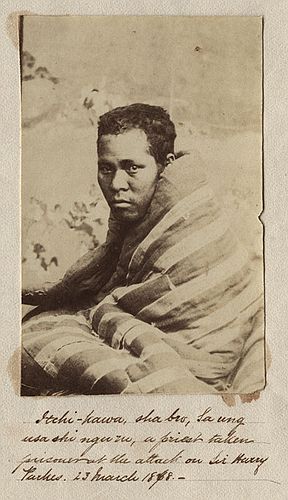
Photographer Frederik William Sutton shows accused collaborator Ichikawa Shaburo prior to his execution (Fuente: Luminous Lint)

This unattributed view shows the head of Parkes' assassin, Hihashida. Penned in ink, possibly by Beato, under each photo reads: "Itchikkawa Shabro, Gaung usashinguzu (?), a priest taken prisoner at the attack on Sir Henry Parkes, 23 March 1868" and "Head of Hi-hashi-da, a medical student (one of the Kioto assassins) who attacked Sir Henry Parkes when going to visit Mikado, 23rd March '68, & was killed on the spot by Yakunin Gotoshojiro, officer of the Mikado court." (Fuente: Luminous Lint)

Felice Beato (attributed). Post-mortem of Lt. Camus - attributed to Felice Beato. Shows the badly mutilated corpse of Lieutenant Camus who was assassinated by anti-foreigner Samurai on the outskirts of Yokohama, Oct. 1863. On the verso of the print, penciled in unknown hand, possibly by Beato, are several graphic accounts detailing the assassination of Camus indicating that Camus was a French Military officer and was assassinated by three Ronin on 10/18/1863, in the suburbs of Yokohama, while on horseback. It indicates that this photograph was taken in order to report the atrocity to France. (Fuente: Luminous Lint)

miércoles, 20 de abril de 2011

1933 F. White, visita a Kamakura


Author: F. White
Date: November 1, 1933
Keystone photo print (Gelatina de plata)
Size: 18.23 cm x 10.61 cm (7.18 in. x 4.18 in.)
Publicado en: Tour of the World (1936). Colección de 1200 imágenes estereográficas. Keystone View Company.
Gelatina de plata
Fuente:  Keystone-Mast Collection, UCR/California Museum of Photography, University of California, Riverside

lunes, 18 de abril de 2011

sábado, 16 de abril de 2011

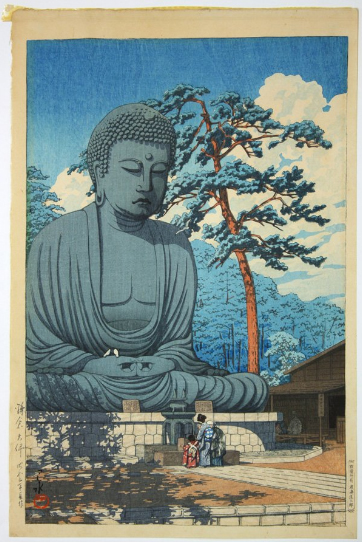
1930 Kawase Hasui, Kamakura Daibutsu

Kawase Hasui (1883-1957)
Kamakura Daibutsu (Great Buddha at Kamakura) [Hotei #204/Narazaki #313A]
Date: left margin dated Showa 5.natsu (1930, Summer), the right margin with oval cartouche of Watanabe Shozaburo (C: 1929-42), 15.5'' X 10.25''
Fuente: Clars Auction Gallery

jueves, 14 de abril de 2011

1880s Temples, Torii, and Daibutsu


Image Title:  Views : Temples, Torii (a Sacred Arch), and Daibutsu (a Great Image of Buddha) (187-?-188-?)
Medium: albumen print
Specific Material Type: Photographs
Item Physical Description: 4 photographs : 9.5 x 14 cm or smaller
Source: [Album of photographs of Japan.]
Source Description: 1 album (67 pl. : 162 photographic prints) ; albumen, col. ; 23 x 28.5 cm or smaller in album approx. 34 x 42 cm.
Location: Stephen A. Schwarzman Building / Photography Collection, Miriam and Ira D. Wallach Division of Art, Prints and Photographs
Catalog Call Number: MFY+ 93-6332
Digital ID: 114288
Record ID: 138958

miércoles, 13 de abril de 2011

2010 Hawaii Hochi newspaper – November 15

Obama: “Mr. Daibutsu, is there anything I can do to help the American economy?”
Daibutsu: “Why don’t you eat American ice cream instead of that Japanese green tea ice cream you are eating?”
(Hawaii Hochi newspaper – November 15, 2010)
Fuente: Almost Editorial Cartoons & Manga

martes, 12 de abril de 2011

1890's Daibutsu at Kamakura, Kazumasa Ogawa

Author: Kazumasa Ogawa ?
Media: Albúmina coloreada a mano,
Fuente: Nagasaki University, Japanese Old Photographs of the Bakumatsu-Meiji Periods
Observaciones:  la colección JOPhB de la Nagasaki University Library atribuye esta imagen a Tamamura Kozaburo o Tamamura Kihei. La leyenda "661 Daibuthu at Kamakura" las identifica como la misma imagen. Baxley Stamps  la atribuye a Kozaburo.

lunes, 11 de abril de 2011

1880's Tamamura Kihei, Daibutsu

Tamamura Kihei (ID5485, 265x205 mm)

Tamamura Kihei (ID 496, 249x193 mm)
Author: Tamamura Kihei (?-1951)

Type: Albumen - Hand Colored
Title/Subject: "661 Daibuthu at Kamakura"
Photograph Studio: Tamamura Kozaburo
Fuente: Japanese Old Photographs in Bakumatsu-Meiji Period (JOPhB)
Observaciones: JOPhB atribuye la imagen ID5485 a Tamamura Kikei, si bien, es idéntica a la imagen ID 496 que si reconoce de T. Kihei. Baxley Stamps dispone de la misma imagen ID5485 pero atribuye la autoría a Tamamura Kozaburo. Si superponemos  las 3 imágenes se observa que son idénticas excepto que la imagen ID 496 ha sido retocada en la copa de los árboles de la parte superior izquierda.
Bio: 
Kihei Tamamura was one of Japan's leading pictorialist from the early days of this movement. He was also the son of Kozaburo Tamamura, the famous Meiji Era commercial photographer who built a photo empire based out of Yokohama. Kihei seems to have turned professional around 1900 and have taken over his father's firm shortly thereafter. He is also thought to have taken many of the classic hand colored tourist views for his father's firm from that time. When the pictorialism movement hit Japan around 1910, Kihei became quite active in this genre and became known as one of the leading Japanese art photographers from 1915 to 1930. When the Great Kanto Earthquake struck Japan in 1923, his father's business was destroyed which may have oddly freed up Kihei to devote more time to his passion of art photography. However the family business was in ruin and never recovered. Kihei's work can often be found in Japanese photo journals and photo annuals during the 1920s including the the Camera Work like photo journal "Hakuyo"; and several of the Japan Photographic Annuals by Asahi Shimbun Publishing in the late 1920s. In the journals from the mid to late 1920s Kihei is always listed as being a resident of Osaka. He is often confused with his father by historians but is easy to identify due to the pictorialist style of his images. (Fuente: Sakura-do)


Tamamura Kozaburo (1856-1923?). Fuente: Baxley Stamps
Author: Tamamura Kozaburo (1856-1923?)
Type: Albumen - Hand Colored
Image Size: 8 1/4 x 10 1/2 inch
Title/Subject: "661 Daibuthu at Kamakura"
Photograph Studio: Tamamura Kozaburo
Fuente: Baxley Stamps 

domingo, 10 de abril de 2011

1890s Daibutsu at Kamakura


Image Title:  Daibutsu at Kamakura
Medium: Albumen prints -- Hand-colored
Specific Material Type: Photographs
Item Physical Description: 23.5 x 18.5 cm (visible dimension)
Item/Page/Plate: [100]
Notes: Number in Negative, 275
Source: Photographs of Japan. Source Description: 110 photograhic prints : albumen, col. ; 19 x 25 cm. in window mounts, 27 x 38 cm.
Location: Stephen A. Schwarzman Building / Photography Collection, Miriam and Ira D. Wallach Division of Art, Prints and Photographs
Catalog Call Number: MFY+ 93-6337
Digital ID: 119545
Record ID: 138557


Mostra un mapa més gran
Related Posts Plugin for WordPress, Blogger...